The Weekly Reframe #11

All change.
1/ I'm now hosting my work on the Ghost platform. The complete archive of my words over the last 10 years is now at www.clives.work
2/ You'll notice this brief comes from a different email [email protected] - you may want to whitelist that to save it going into spam.
Let's start.
1/ Notice
When hitting your target misses the point.
A client bragged they’d hit 150% on their “growth targets” last year. Results hadn't increased that much, so I asked what that meant.
“Well,” they said, “we booked 40% more intro calls.
No mention of revenue. No new clients. Just more conversations.
The kind that end with, “Let’s circle back next quarter.
This made me stop and think: I've watched this pattern for 30 years—smart leaders optimising for the wrong outcome because that's what the dashboard rewards. When a measure becomes the target, it stops measuring what matters.
Goodhart’s Law, in action.
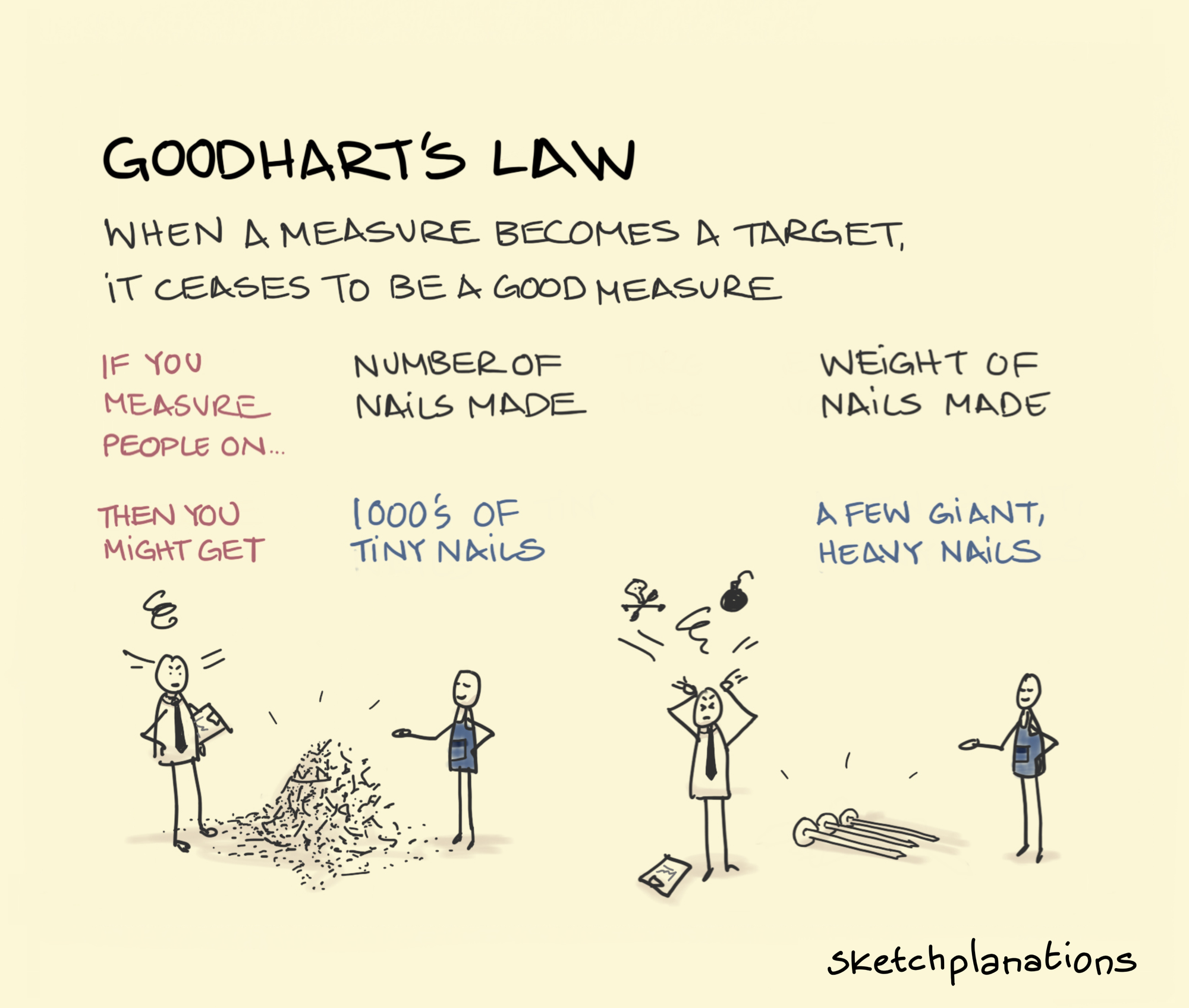
I’ve seen consulting firms celebrating “pipeline value,” where a half-hearted prospect chat gets logged at £500k “potential.” By Q4 the dashboards glow, and the P&L coughs.
Or marketing teams rewarded for “client engagements,” which means anyone who clicked anything gets filed under “active relationship.” In the spreadsheet, it looks like growth. On the ground, nobody’s buying.
Once you attach rewards to a single metric, the game changes... you don’t get better performance, you get better gaming.
The smarter play?
Use a few imperfect metrics that force trade-offs - revenue and retention, pipeline and conversion. And then add one thing you can’t formula-ify: judgment.
The truth always leaks through the numbers, if you make time to look.
“When a measure becomes a target, it ceases to be a good measure.”
— Charles Goodhart
Watch: Examples of Goodhart's Law and why you should have faith in your own creative output.
2/ Do
Stop guessing.
Most people fall in love with their own ideas before they’ve spoken to the potential user - another human
You know what I mean. How you've see the problem and then rush to design a "fix." It’s dangerous.
Problem situations are seldom a collection of random and separate parts; they're systems. And systems relies on things like flow, speed, and standards.
When you try to shoehorn a new solution into a problem situation the system reacts - often negatively. If jump in, without understanding the system at depth, you won't get improvement. You'll get friction. You'll get leakage. You'll upset the ecology.
The only way to avoid this is to stop guessing and start talking.
Get into the weeds. Speak to the people who actually do the work. Ask them what breaks the flow. Research excellence isn't a survey. It's a conversation.
If you don't understand the system, you have no business trying to change it.
Read this piece on coffee cups below. It’s the perfect example of why listening saves you from building the wrong thing.
Inspired by: Reusable cups and cafe systems
3/ Question
What are you putting up with?
You get what you settle for.
If you let it slide without saying a word, you’ve just agreed to it.
Stop walking past it.
A few examples to stimulate your thinking:
"He’s a nightmare for the culture, but his sales numbers are too good to lose."
"That proposal was sloppy, but I didn't have the energy to make them redo it."
"The client treats us like staff, not partners, but we need the revenue."
"I’m still fixing this myself because it’s quicker than training someone else."
Ask yourself: Where are you choosing an easy life over a high standard?
Hit reply and share your takeaways this week.
That's it until next week.
Clive
Clive Griffiths Newsletter
Join the newsletter to receive the latest updates in your inbox.